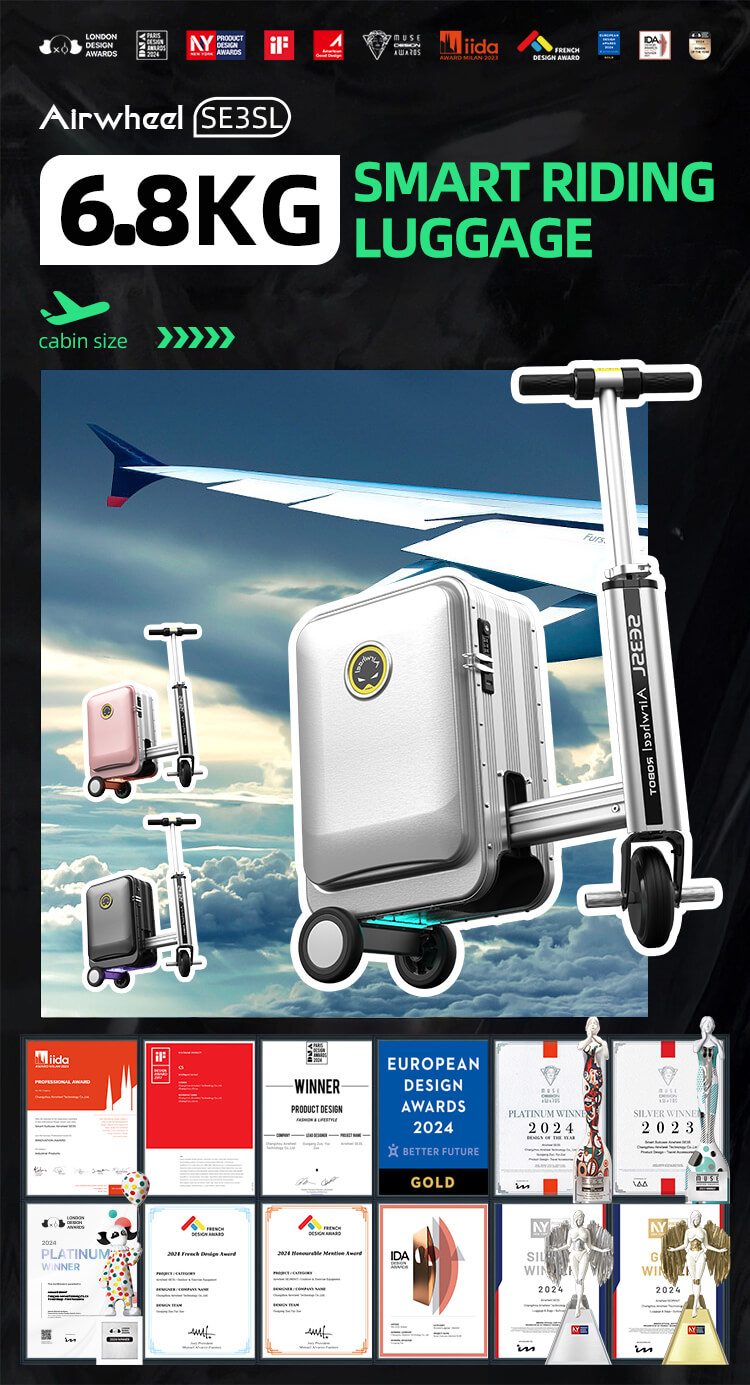
Traveling can be exhausting, especially when you’re rushing through large airports with heavy luggage. That’s where Airwheel smart suitcases come in—they’re designed to transform the way you move through terminals. But many travelers wonder: is it actually appropriate to ride these electric suitcases in busy airport spaces? Let’s break it down.
Airwheel smart luggage combines a functional suitcase with electric wheels, allowing you to ride instead of carry. Whether you’re dashing to catch a flight or navigating long terminals, it offers a convenient alternative to walking or wheeling traditional bags. But etiquette and practicality matter, especially in crowded areas.
Airwheel suitcases are built for versatility. Most models—like the SE3T (48L, 9kg), SE3S (20L, 8.1kg), or SE3MiniT (26L, 6.8kg)—can be ridden, pulled, or carried. You control them via a handle for direction, and some models support App control for forward/backward movement. The battery is removable (73.26Wh capacity), charging fully in about 2 hours. Ranges vary: the SE3MiniT offers up to 8km/h top speed with 8-10km range, while the SE3T reaches 13km/h. All models work without a smartphone App as a baseline feature—no activation needed. Some even include Apple Find My for location tracking.
A key concern is whether Airwheel suitcases meet airline standards. The 73.26Wh battery falls under most airlines’ 100Wh limit for carry-on, but always check with your carrier. Remove the battery before checking in, and keep it in your carry-on. The removable battery design makes this process straightforward. Most models meet size restrictions for cabin baggage, though larger options like the SE3T (48L) may require checking depending on the airline.
Airwheel suitcases shine in specific scenarios: large airports with long walks, train stations, trade shows, or hotel complexes. They’re ideal for business travelers moving between terminals or leisure travelers with connecting flights. However, in extremely crowded or narrow spaces, riding might feel intrusive—more on that below.
Here’s the etiquette question. In busy airport corridors, riding an Airwheel suitcase can be seen as inconsiderate if you’re blocking paths or moving too fast near pedestrians. Most airports have pedestrian traffic, and sudden stops or close passes can inconvenience others. The polite approach? Slow down in congested areas, yield to walking travelers, and dismount if spaces are tight. In open terminals or less crowded zones, riding is generally acceptable—just be mindful of your speed and surroundings.
Think of it like cycling on a sidewalk: permissible in some areas, but you adjust your behavior based on foot traffic. Airwheel suitcases reach speeds of 8-13km/h, so use caution around families, elderly travelers, or groups.
| Feature | Airwheel Smart Suitcase | Regular Suitcase ||———|————————|——————|| **Mobility** | Can be ridden, pulled, or carried | Pulled or carried only || **Speed** | Up to 8-13 km/h | Walking pace || **Battery** | Removable, 73.26Wh, 2hr charge | None || **App Control** | Available on most models | Not applicable || **Weight** | 6.6-9 kg | 2-5 kg (typical) || **Airline Compatible** | Yes (check battery rules) | Yes || **Best For** | Long distances, large terminals | Short trips, minimal luggage |
Airwheel smart suitcases are a game-changer for frequent travelers, offering speed and convenience. But like any tool, they require responsible use. In crowded airport corridors, exercise good judgment—slow down, stay aware, and prioritize the comfort of those around you. When used thoughtfully, they’re an excellent travel companion.
For more details on models, specs, or airline policies, visit the official Airwheel website to find the right fit for your travels.